
Predictably Irrational By Dan Ariely

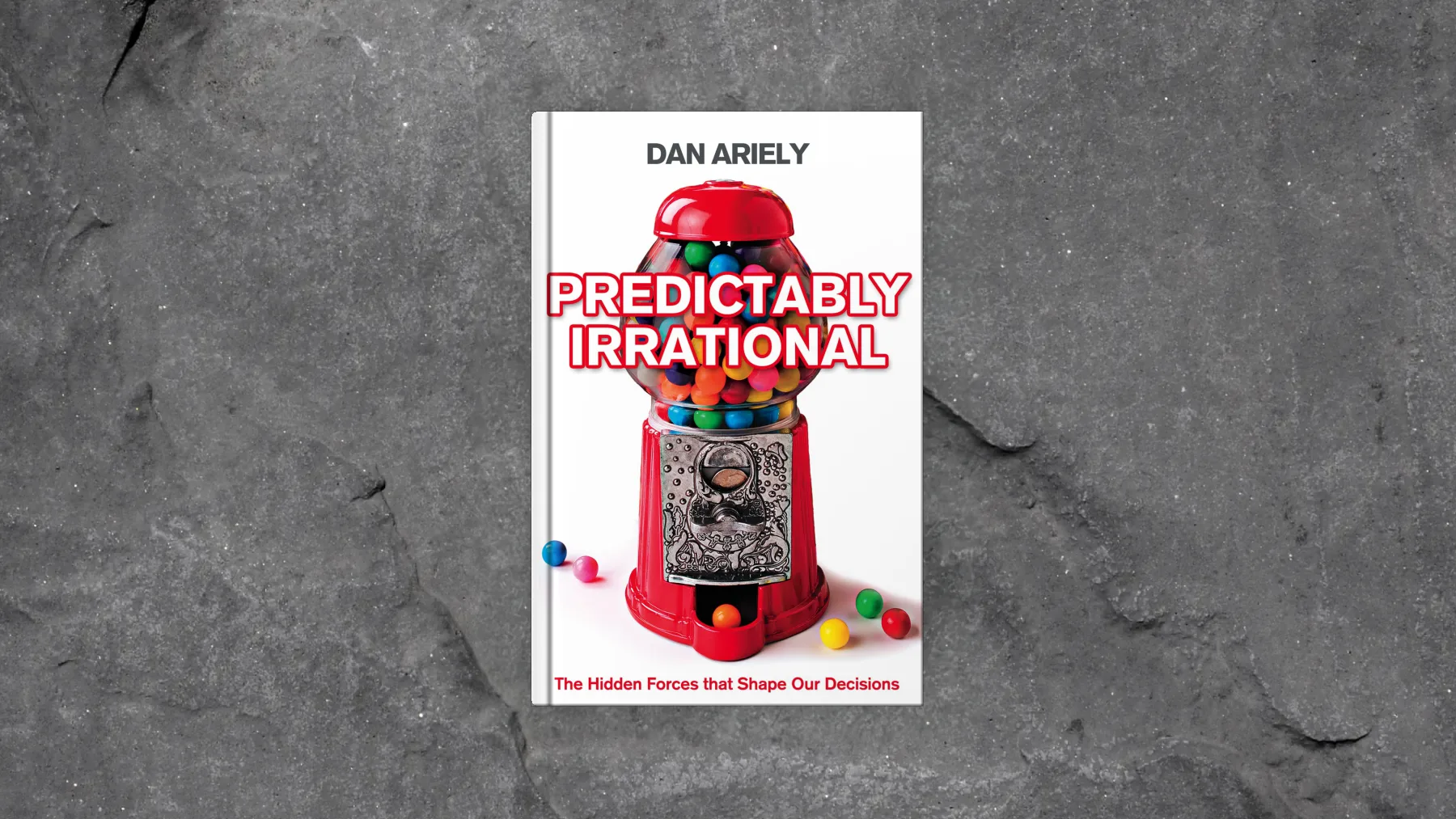
Why we buy what we buy, explained through experiments. Dan Ariely proves that nobody is as rational as they think.
Economics textbooks assume people weigh up their options sensibly and choose what’s best for them. Dan Ariely, a behavioural economist, spent years running experiments that suggest otherwise. Predictably Irrational, published in 2008, collects the results.
The key word is “predictably”. We don’t make mistakes at random. We make the same ones, in the same ways, again and again—which means they can be understood, and designed around. That’s good news for anyone in marketing.
Ariely covers why we struggle to judge value without a comparison, why the word “free” makes us behave strangely, and why paying someone can sometimes make them less willing to help. Each chapter builds on an experiment, told in an easy, conversational style.
Pivotal takeaways
- Everything is relative. We rarely know what something is worth on its own. We judge it against whatever sits next to it.
- Decoys change decisions. Adding a clearly worse option can make another one look far more attractive. Pricing pages know this well.
- Free is a special price. Zero isn’t just a lower number. It triggers an emotional response that can override good judgement.
- Social norms beat market norms. Mix money into a relationship built on goodwill and you can quietly damage both.
Why it’s a must-read
At Pivotal, we test constantly, and this book is a reminder of why. What people say they’ll do and what they actually do are often very different. Ariely gives you a head full of hypotheses to try on pricing pages, offers and forms.
It’s also a very accessible introduction to behavioural economics. If you’ve never read anything on the subject, this is a friendly place to start. Every chapter ends with a practical thought on what the findings mean for everyday life and business.
One caution: behavioural science has been through a period of hard scrutiny since the book came out, and not every famous finding has held up. Treat the studies as ideas to test with your own audience, not rules to follow blindly.
Rating: ★★★★☆
Entertaining, eye-opening and full of ideas worth testing. Read it with a curious mind and a slightly sceptical one. Then run the experiment yourself, because your customers are the only evidence that really counts.
Discussion time. What’s the most irrational purchase you’ve ever made—and why did it feel right at the time? Share in the comments, and let’s compare notes.